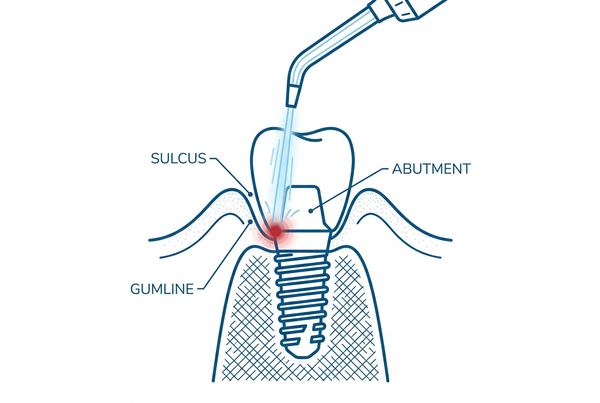
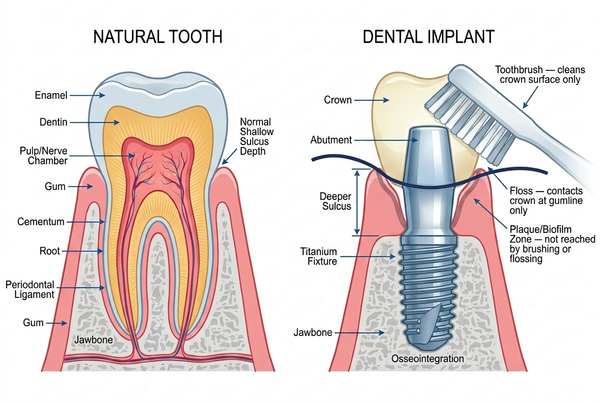
Dental implants don’t get cavities the way natural teeth can. The tissue and bone that support an implant still need daily attention, because plaque can build up in places a toothbrush doesn’t easily reach.
How implant tissue is different
Around a natural tooth, gum tissue and a periodontal ligament help form a seal and bring blood supply. An implant fuses to bone without that ligament. The soft tissue forms a cuff around the abutment, and the small groove along that cuff (often called the sulcus) can be deeper and harder to clean than around a natural tooth.
Geometry matters too: crowns often flare wider than the post underneath, leaving a ledge below the gumline where bristles can skip past.
Plaque and why daily cleaning matters
Plaque is a sticky film of bacteria. Left undisturbed along the gumline and in hard-to-reach spaces, it can irritate the soft tissue. That’s why implant patients are usually asked to be thorough at home — brushing, cleaning between and around restorations, and often irrigating — and to keep the maintenance visits their dentist set.
Terms you may hear at a checkup
Your dentist or hygienist may use clinical terms such as peri-implant mucositis or peri-implantitis when talking about inflammation in the tissue (and, in more advanced cases, bone) around an implant. Only a dental professional can diagnose those conditions. This page is general education, not a diagnosis checklist and not a treatment plan.
If you notice bleeding, persistent redness or swelling, discharge, looseness, or new discomfort around an implant, contact your dentist. Home care is not a substitute for that visit.
A daily routine that matches implant anatomy
- Brush twice daily with a soft brush, angled toward the gumline around the restoration.
- Clean between and around implants daily (interdental brushes, floss, or threaders sized for your sites).
- Irrigate with a water flosser at low-to-medium pressure, tracing slowly around each implant.
- Keep your professional maintenance interval.
Ask your dental team to show you technique for your specific restorations.
The section above is general education. Below is product information for people who irrigate as part of daily care.
A daily irrigator habit many implant patients use
Targeted care for dental implants.
Implant ProCare is formulated for daily use by implant patients. It is a 2× irrigation concentrate: mix 1:1 with water and fill your oral irrigator reservoir (or use a curved-tip syringe as directed on the label).
Use: Helps control plaque that leads to gingivitis.
It is an over-the-counter antigingivitis/antiplaque oral hygiene product. It does not replace brushing, interdental cleaning, or professional care.
See Implant ProCare (coming soon)
Implant ProCare is not intended to diagnose, treat, cure, or prevent any disease, including peri-implant mucositis or peri-implantitis. It is not a substitute for professional dental care. Talk with your dentist about the home-care routine that fits your implants.
Labeling subject to final formula approval where applicable. Coming-soon / waitlist mode — not a live purchase offer.