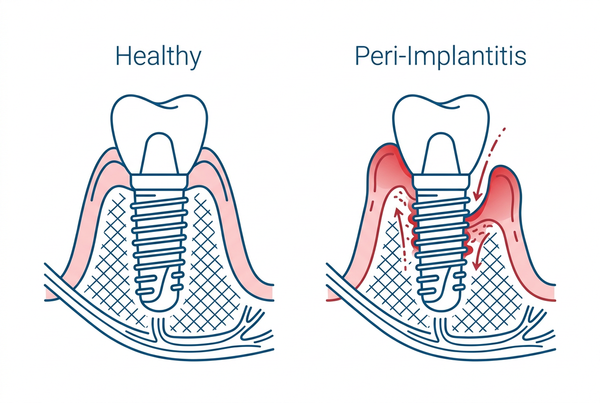
If you have one or more dental implants, you've probably been told that caring for them isn't quite the same as caring for your natural teeth. That's true — and understanding why can help you build a daily routine that matches implant anatomy.
The tissue around an implant is different
A natural tooth is anchored by a periodontal ligament, a network of fibers that connects the tooth root to the jawbone and helps supply blood flow and immune response to the surrounding gum tissue. An implant doesn't have this — the implant post is anchored directly to bone (a process called osseointegration), and the soft tissue around it (the peri-implant mucosa) attaches differently and has a comparatively limited blood supply.
The practical result: the tissue around an implant can be more vulnerable to irritation from plaque and bacteria, and once inflammation starts, it may progress differently than it would around a natural tooth.
Plaque collects in different places
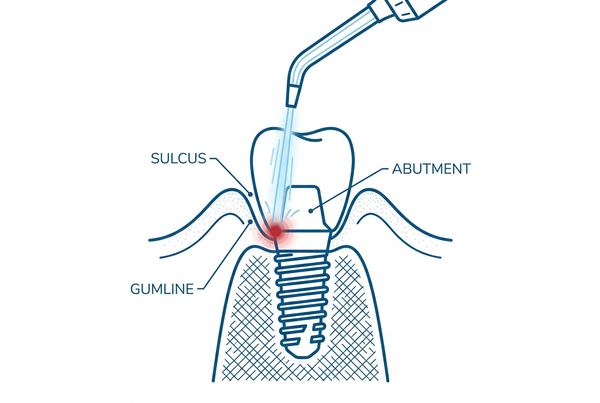
Implants have a small gap, or sulcus, around the abutment (the connector piece between the implant post and the crown). This space can be harder to reach with a toothbrush alone, especially if you have a crown, bridge, or implant-supported denture that limits access. Plaque that builds up here undisturbed can irritate the soft tissue. Dentists may discuss inflammation around implants at checkups — only your clinician can assess your sites.

Daily irrigation flushes the full depth of the sulcus around the implant — reaching where a toothbrush and floss can't.
What dentists commonly recommend
Because of these differences, many dentists recommend a daily routine that goes beyond brushing and standard rinsing for implant patients:
- Brushing at least twice daily with a soft or implant-safe brush
- Daily interdental cleaning (floss, interdental brushes, or a water flosser) specifically around the implant site
- An oral rinse or irrigation solution formulated for daily use by implant patients, used as directed
- Regular professional cleanings and checkups, often more frequent than for natural teeth
This is where a product like Implant ProCare can fit in — a 2× concentrate mixed 1:1 for the irrigator reservoir. Use: Helps control plaque that leads to gingivitis.
The bottom line
Implants are durable, but the soft tissue and bone around them still need daily attention. A routine built around your implant's specific anatomy — not just a copy of your old natural-teeth routine — is one of the best things you can do for daily home care. Talk with your dentist about what’s right for you.
This article is for general educational purposes and isn't a substitute for advice from your dentist. Talk to your dental provider about the care routine that's right for your specific implant and health history.
Have a question we didn't cover? Check our FAQ or contact us.